Speakers for the Dead
Paul Pine's Poetry book Divine Madness & Dave Seidel's album Homage to Hennix

In a recent episode of Josh Datko’s poetry on tape, he made a comment on my music writing and how much praise and love music writers give to musicians. He wants to see the same kind of support for poets. I’d like to see that as well, so I will endeavor to send some more love to the writers I have been reading in this lifetime, along with all the music I love to explore. For me, the two are really intertwined anyway. Working at the public library my entire adult life has given me the access to explore all the different things I find interesting: books, music, artwork and film. All of these mediums are just means of expressing the art spirit that animates imaginative creativity of those who have tuned themselves to become vessels and receivers for its divine expression.
To start, I will share this review that I wrote not long after the book came out in 2012. At the time I had been a member of The Walnut Street Poetry Society for several years. This group that met once a month at the membership-based private Mercantile Library (a true gem in Cincinnati) to discuss poetry. The sessions were, and still are, run by poet and professor Norman Finkelstein. When my job changed locations to a new building, it was no longer convenient for me to attend this poetry group, which happened down town on my lunch break, but the group celebrated its 20th year in 2024. I am happy to see it is still going strong.
Besides the discussions of poetry past and present, the group would organize readings and invite in different poets to give talks. One of those poets was the late Paul Pines who then quickly became my one of my favorite living poets. Now he is in the realm of the ancestors, but his words still speak to us the living.
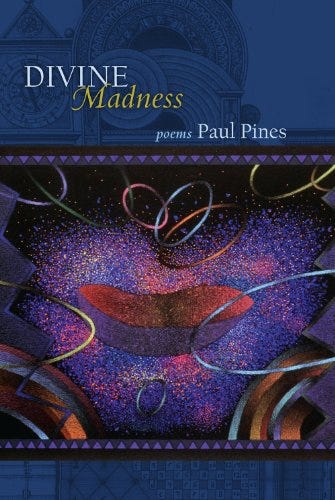
Divine Madness is a liminal book. It traces the inner lives of a number of visionaries who dwell in the margins of our culture. & It looks at both gods and men, to see where they have been cracked, and shines a light through the fissure to create a pattern of connection. These poems about people expose the places where the tower of human society has also cracked, and makes a game of building out of the resultant rubble.
Paul Pines has listened to the dead whisper, and in these poems, he becomes a speaker for a diverse assembly of cultural ancestors. Thomas Paine rubs elbows with Leonard Bernstein. Columbus and Giordano Bruno are enshrined with Audubon and Telemachus. Pine’s ear has been attuned to their voices, and now he can share the same ear that the great Mayan, Chan-Bahlum “pressed to the spirit tube / on the platform / of the Temple of The Inscriptions / at Palenque” and so can empathize with the life of Van Gogh who “chewed so much foxglove / his world turned yellow.” In listening closely to these lives touched by the madness of the Muses, Paul is able to show his readers that “the voices of the gods make us / ciphers for what cannot / be deciphered”.
To truly listen to the dead speak, the volume knob of reason will need to be turned down. “We who are trapped / in a nation / of lost intimacies / can’t hear // what the dead / buried / in our hearts// ask us to honor / in their name”. Peoples boundaries have become rigid. The veil separating the living from the dead has become thick, where once it had been thin. The underworld is a clogged sewer, filled with all the things humanity rejects. Children feel this “unspoken / terror of our fear”. To really sit and be with the fear requires the person who has been infected with divine madness to go and sit on the edge, between sanity and lunacy, between wilderness and civilization, between the outer person made of skin, bones, body, and the inner self, of our imagination, the shining body, and the eternal flame. Paul Pines has become comfortable walking these edges.
Vulcan is another edge-walker who appears in the pages of this book, “whose hairy blacksmith hands” can make “a net of fire in water” or a net of words thrown across the page in brief dancing lines. The spaces in between those lines make another kind of confluence, just as the workshop of Vulcan lies deep beneath the oceans waves in a cavernous cleft of volcanic lava.
The artisans of culture sit forever betwixt the crossroads on the outskirts of town. They are exiles, whether from Olympus or Eden. They are alchemists who take the raw ore buried in the earth and forge it into the ploughshare that is also a sword. Agriculture and warfare are the uneasy twins of the city-state, progeny of the blacksmith. The inspired gifts brought forth by the hands of the metal worker are both fearsome and awe-inspiring. These poems elicit a similar response in how they mediate Paul’s encounters with the numinous. The terror and ecstasy which come from making contact with powers and beings outside of oneself are awe some and inspire awe.
Yet these words also speak to the “alchemists / of the every-day heart” who experience the “coagulatio et separatio” even as they “punch a clock / drive kids to school //support the weight / of a routine”. I may meet gods and daimons in the inner worlds but I come back home to my wife and children and work. Even if I climb Jacob’s Ladder to the stars and their starry heavens, I return to this place of my body and face the mortality of this particular body. Paul writes, “His wife kisses him / then turns away / a pillow tucked to her chest // awake in the hotel room / afraid of death / he counts possible years / left // calculating his daughters age / if he lasts twenty more”.
This where Paul Pines excels. He sends the reader out on a “raft of snakes” into the terra incognita, pushing the voyager to cross boundaries and seek new horizons, and then he shows the common rubble everyone must contend with, and brings it all back home, into the present, making Divine Madness something that anyone can aspire to be touched by.
The book was originally published by Marsh Hawk Press, but is now selling for a ridiculous price. (Pines passed away in 2018.) Thankfully for those who don’t have $199 to spare on a small paperback poetry book, you can borrow the book from the Internet Archive.
His essays, fiction and other poetry books are all worth seeking out.
Everyone wants to talk about alternate tunings ever since some people in polka dot costumes popularized the idea of microtonal music. Those people are the duo Angine de Poitrine in case you were wondering.
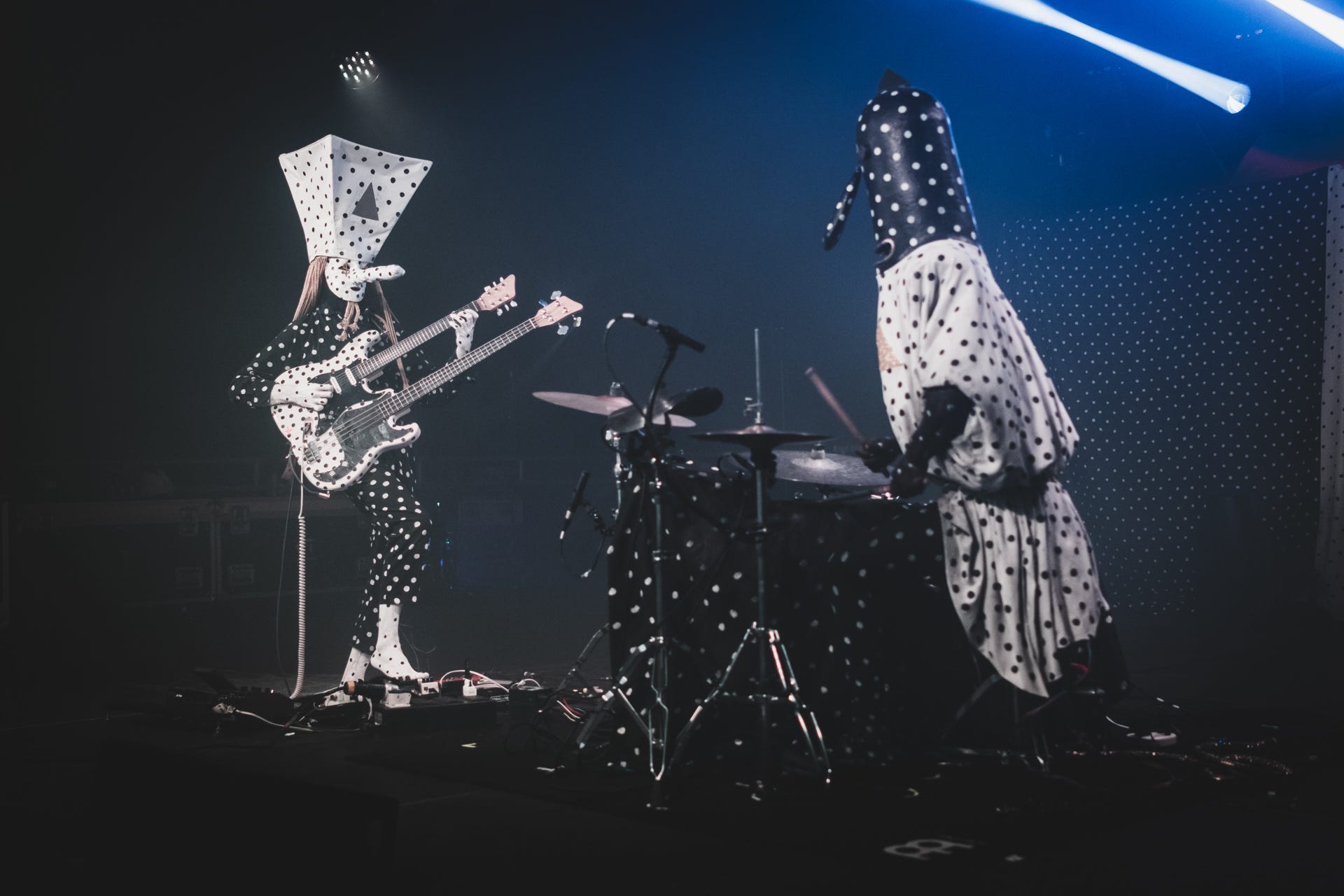
As if people hadn’t been exploring alternate tunings for much of the twentieth century already. As if, alternate tunings are just different ways of looking at notes. As if microtonality wasn’t just a way of using the notes between the notes. I wrote some notes in the following review about one of my favorite contemporary explorers of such tunings, Dave Seidel, and his homage to another explorer of such tunings, the late Catherine Christer Hennix who passed away in 2023.
DAVE SEIDEL: HOMAGE TO HENNIX:
THE ELECTRIC HARPSICHORD REINTERPRETED
It is good to hear another contribution to the genre from Dave Seidel, whose homage is a masterpiece in its own right. That’s no surprise considering how as a musician, he continues to stay true and in tune with his own musical vision, all while extending the techniques of the masters who went before him.

A kaleidoscopic roulade
Some music has the uncanny ability to open portals to transcendent experiences. This is one of those pieces of music, and it is based on another classic reality ripper that opens portals to new worlds of listening. Drone music in particular seems to have this as a built-in feature, though it isn’t necessarily unique to drones. Rhythmic pulsating percussion can do rend ruptures just as readily. Yet long durations do seem to be one of the elements of the kind of reliable music to open a door in perception. A quick pop song doesn’t really last long enough to alter awareness. If it does, it is quickly changed again when the next pop hook comes in with its claws and earworms to embed itself in the listener. Drones on the other hand have a tendency to root themselves inside the listener in a different way, at least in my experience. Music like this has the power to take me out of myself, get me out of my head, and take me on voyages into the imaginal realms. It starts with a subtle sustained tone, and then bass chords reverberate over top, after a brief harmonic ascent. Then this track blisters and blooms into a kaleidoscopic roulade that rotates like a dizzy merry go round in the stereo field.
This drone, with its lustrous ornamentation laid over the top, is as it says in the title, a homage to a work by the late minimalist musician, mystic and mathematician Catherine Christer Hennix. Hennix was a part of the circle of musicians taught by Pandit Pran Nath. Pandit Pran Nath was himself a master of the Kirana gharana style of classical Hindustani singing who counted La Monte Young, Marian Zazeela, Terry Riley, Don Cherry, Henry Flynt and Jon Hassel as his other musical students, among others. All of these musicians who studied under Pandit Pran Nath have left unique marks upon musical culture. They are part of what I call the Nath constellation of artists, whose glittering light as stars, I like to bathe under.
Some of the stars in the Nath constellation are more well-known, daddy La Monte perhaps the most. Yet the work of the others, including Hennix, deserves to be more widely heard. What all of these students had in common was a tendency to employ unique tuning systems and Just Intonation. Dave Seidel also works in this tradition, employing uncommon tunings across his releases.
Employing uncommon tunings across his releases ::
For Hennix’s work, she used the harpsichord setting on a Yamaha keyboard that had been retuned according to Alain Danielou’s “Ragas of Northern Indian Music” for the North Indian Multani scale. Since Seidel’s work is not an exact recreation of the Hennix piece but a homage, he follows part of the blueprint Hennix left behind (as noted by Henry Flynt) to create his own fantasia on her theme.
Seidel uses a set up that includes two Meng Qi Wingie2 resonators that he loaded with a custom firmware to be able to achieve the tunings he enjoys. These small units deliver incredible sound. One is used for bass and melody and the other he uses as a resonator, in a manner akin to the way a sympathetic string will resonate. Hennix accompanied her piece with sine wave oscillators, where Seidel uses a sine wave he created in Csound. All is awash in a wondrous reverb that cascades and echoes with the arpeggiations from his playing.
Like the albums Khemia and Alchemeia, from the Magic Carpathians and Scanner respectively, Seidel’s composition goes extremely well when paired with its namesake from Hennix. Each are just under twenty-five minutes, so listening to both, in whatever order, makes for a fine listening session. Though each track is enough to really get you into the zone on its own, when heard together they pack a sublime wallop.
Another work that is good to combine in on such a listening session would be Henry Flynt’s “Stereo Piano” from 1978 which has accompaniment from Catherine Christer Hennix. Flynt had been inspired by the work of his friend. He wrote that, “It’s likely that I first heard The Electric Harpsichord in the summer of 1976. My first reaction was that it did not sound like it came from planet Earth… I saw The Electric Harpsichord as initiating a new genre. I thought she and I, or anybody, should produce more works in the genre, not only because they would be valuable in themselves but to show that The Electric Harpsichord was not a fluke.”
Hence “Stereo Piano.”
“Hennix applied her ‘billowing cloud’ keyboard technique to a scale of mine, on an acoustic piano; I subsequently layered the recording. It was the only contribution to the genre on which Hennix and I collaborated.”
It is good to hear another contribution to the genre from Dave Seidel, whose homage is a masterpiece in its own right. That’s no surprise considering how as a musician, he continues to stay true and in tune with his own musical vision, all while extending the techniques of the masters who went before him.
Homage to Hennix (The Electric Harpsichord reinterpreted) is available on Bandcamp.
This review originally appeared in Igloo Magazine in April, 2024.
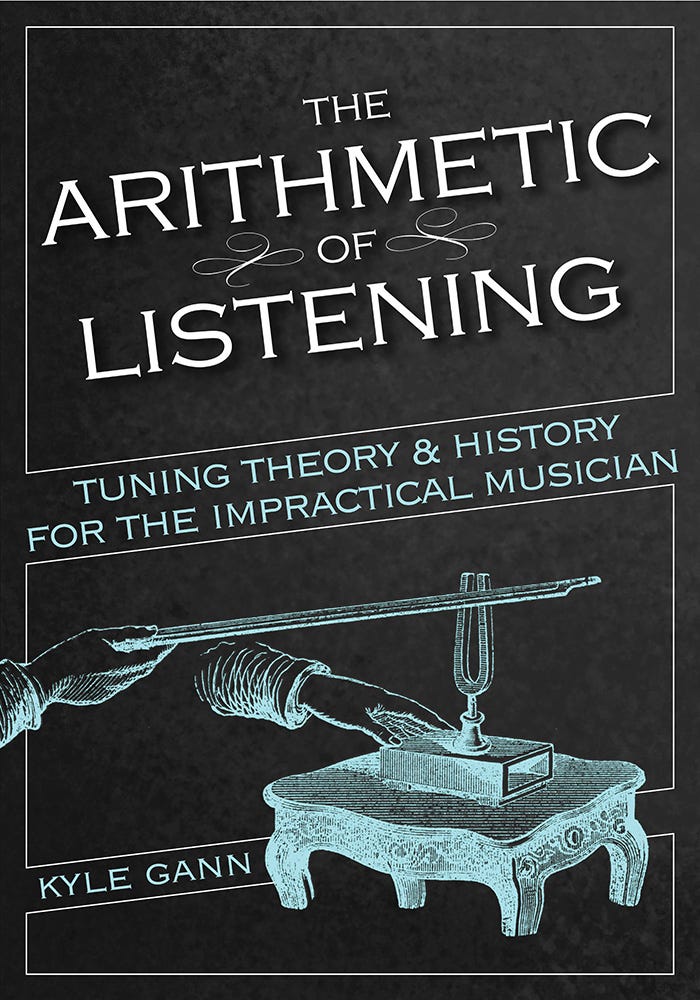
For those who want to explore the fascinating topic of alternate tunings further, I recommend the bible on the subject written by Kyle Gann, The Arithmetic of Listening: Tuning Theory & History for the Impractical Musician.
From the publisher:
“ ‘Tuning is the secret lens through which the history of music falls into focus,’ says Kyle Gann. Yet in Western circles, no other musical issue is so ignored, so taken for granted, so shoved into the corners of musical discourse.
A classroom essential and an invaluable reference, The Arithmetic of Listening offers beginners the grounding in music theory necessary to find their own way into microtonality and the places it may take them. Moving from ancient Greece to the present, Kyle Gann delves into the infinite tunings available to any musician who feels straitjacketed by obedience to standardized Western European tuning. He introduces the concept of the harmonic series and demonstrates its relationship to equal-tempered and well-tempered tuning. He also explores recent experimental tuning models that exploit smaller intervals between pitches to create new sounds and harmonies.
Systematic and accessible, The Arithmetic of Listening provides a much-needed primer for the wide range of tuning systems that have informed Western music.”
.:. .:. .:.
Thank you to all of my paid subscribers for keeping me caffeinated!
The writings presented here will always be free and never paywalled, but there are a few ways you can support my work: pass on the essays on to others, share the links to other sites and telling your friends. You can take out a paid subscription to this subslack if you’d like to be a patron to the arts as represented here. I have also set up a Buy Me A Coffee page, which you can find here if you would like to put some money in my rainy day coffee jar. You can buy my book The Radio Phonics Laboratory: Telecommunications, Speech Synthesis, and the Birth of Electronic Music, or my poetry book Underground Rivers, if you want to show some support and keep my writing in circulation. Thank you to all my readers and supporters. Your generosity means the world and helps support my universalist bohemian art life! Thanks for keeping me caffeinated and wired.
☕️☕️☕️
Once again, you provide quite a few fun rabbit holes to go down. Thanks again, Justin! Paul Pine's work looks very interesting.
I don’t play out of tune — I’m doing microtones! :) I think drones, in music and in life, can be a bit unsettling. Why do they keep going on? Where is the resolution? It’s all tension. I do like them for effect.
That de Poutine album though, I love their energy! I’m not sure I want to buy their record though. If I heard it before I saw it I’m not sure I would like it.
Great article Justin!