Getting Away From It All
A Cheap Thrills Vacation Primer to Beat the Heat

May Day marks the halfway point between the spring equinox and the summer solstice. It’s also the time of year when people start really figuring out what they are going to be doing for their summer vacations if they are lucky enough to take one. While it may not yet be blazing hot, the humidity and higher temperatures are coming, at least on this side of the hemisphere. With that in mind I share this Cheap Thrills article on what beating the heat might look like in a world of accelerated climate weirding and lower resource base. Along the way we take a dips in the lake at a summer Chataqua, hang out with Thoreau at his cabin, visit a bungalow in the borscht belt, and stop off for some gelato before having a siesta in the height of Ferragosto.
This article was originally written for the summer 2025 issue of New Maps and was edited by Nathanael Bonnell.
“Deep summer is when laziness finds respectability.” – Sam Keen
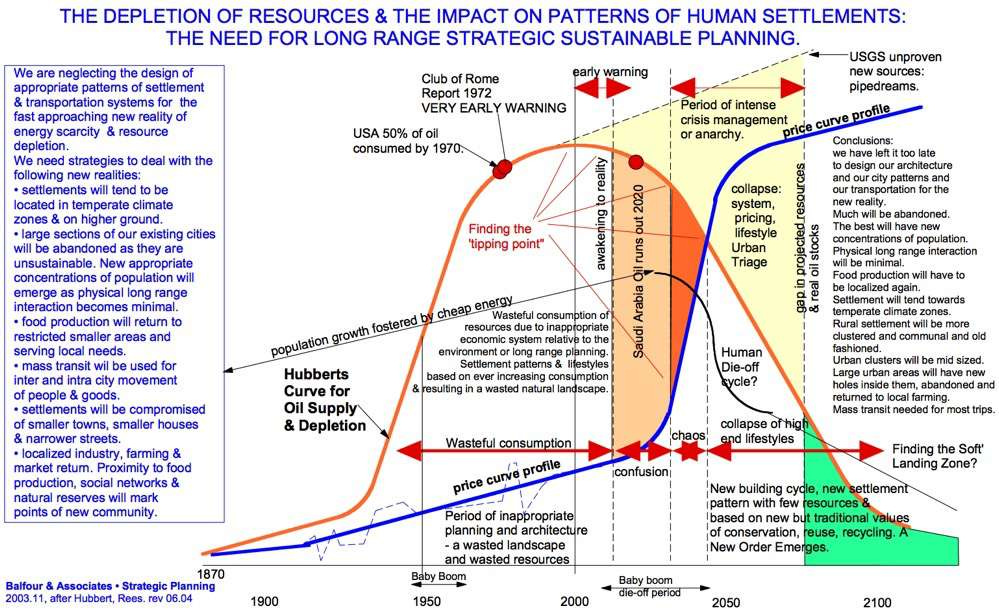
Sometimes you just want to get away from it all. Hit the road. Get out of Dodge, go someplace else for a little while, and then come back. One word for it is vacation. People really started going on them when the railroad hit its stride. The car, bus and airplane expanded the options of where to go, and for a time, long distance travel was relatively affordable. It can now be expected to become quite expensive again in the years ahead, thanks to the downward-sloping curve of Hubbert’s peak. Feeling that pinch doesn’t mean folks aren’t going to want to hit the escape button, though, as vacations have become a habit for the world’s industrial denizens.
Vacationing is, for the most part, a product of our industrial culture. Up until the middle of the nineteenth century the word itself generally meant a time when teachers and students vacated the schoolhouse. The main reason for vacating the schoolhouse was to get busy with the other work that needed to be done in the prime of growing season. To actually take a break from work, people had to have a bit of money, making vacations and resting cures the domain of the wealthy. As the oil gush of prosperity drove everyone’s fortunes up, the middle and working class were able to start taking a break too. A bit of surplus meant that taking a week off for a bit of rest and relaxation didn’t have to drain the coffers to their dregs.
Nineteenth-century physicians started to advocate that such breaks were good for the nerves, while other advocates of leisure suggested that they could be used as a time of spiritual renewal. This was all in contrast to the way many Puritans and Calvinists preached the gospel of work from the pulpit, proclaiming that idleness created a playground for the Devil. As more liberal forms of Protestantism such as Unitarianism came to the fore, they pushed back on this work ethic, and contributed to the idea of the good that could be had by taking a break. The influence of the Transcendentalist movement, and their ideas of taking time for reflection and self-culture, played no small part in this change of attitude.
The practice of going on a vacation is something that can be saved as a habit of leisure even as the industrial economy continues to decline. Adjustments into how far and how often a person will travel will need to be made, especially by those belonging to the international jet set class. Even those of us who are used to more modest vacations will need to change our expectations. The days of hopscotching across the globe in planes are, in the long run, numbered. Most folks never could afford to go even to the other side of the country, much less another continent, anyway. Finding contentment in our home counties, states, and bioregions will be one of the waves future vacationers aim to catch. Meanwhile, those with an entrepreneurial spirit, and who live in the right kind of place, might even be able to cater to the wants and needs of future travelers as a secondary source of income in a time of decline.
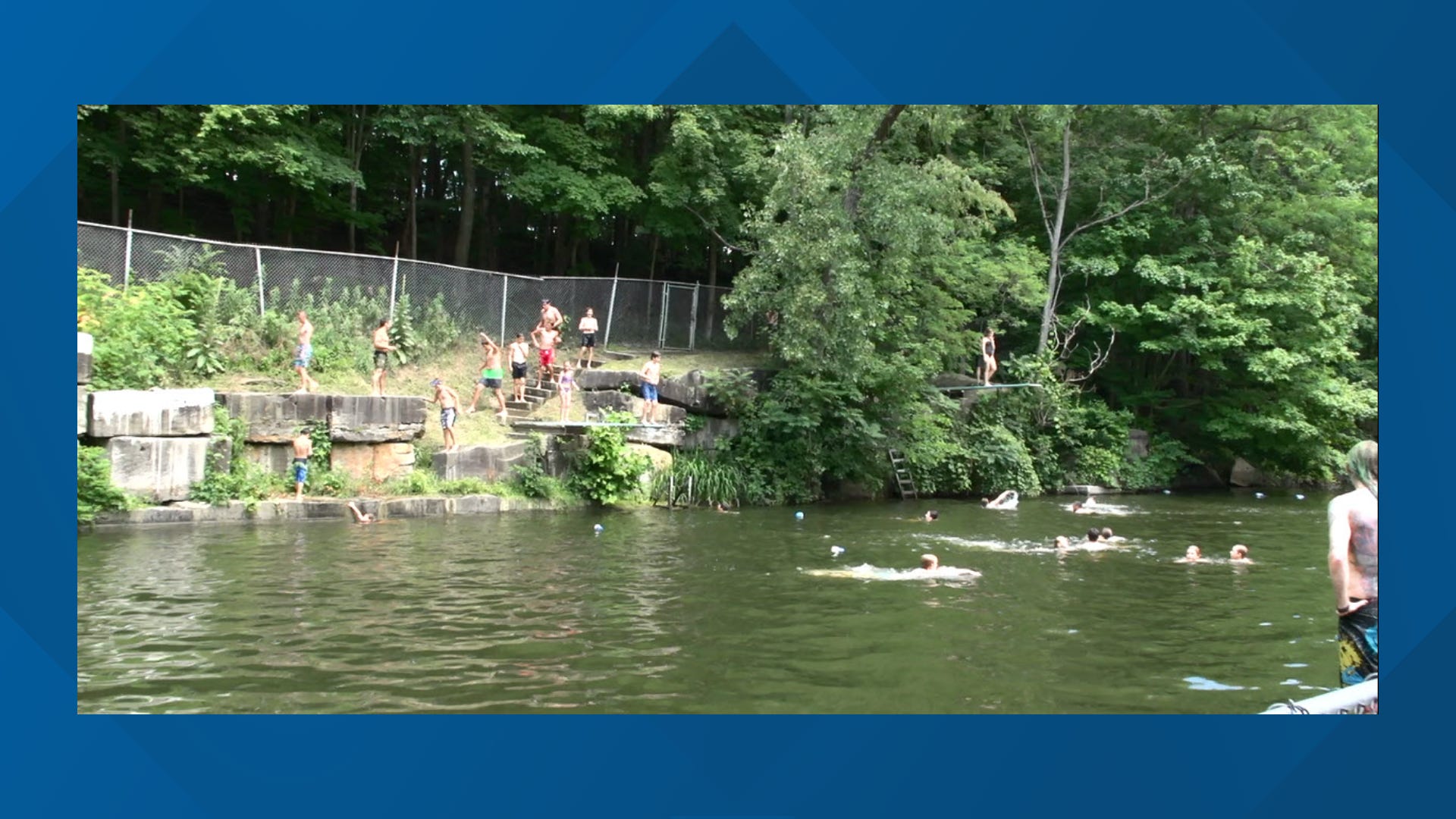
The issue of climate change and seasonal work is not unconnected to vacation. Decline brings with it many difficulties, and one of them will be adjusting to harsh outdoor work as the limitations of air conditioning begin to assert themselves. Summer is the traditional time of a break from school in the United States. This was ostensibly tied to the needs of farmers. Extra hands were needed in the barns and fields during the long hot days. Yet hot days also make hard work more difficult. In places like Italy, where the summers can be as humid and scorching as here in Ohio, it has become tradition for most of the country to take off for at least the first two weeks of August. One way to cope with increased heat is to slow down and go for a swim.
The exact patterns around vacationing will be different in Illinois and Indiana compared to Texas or Maine. For one thing, many people in North America are landlocked, and it won’t be so easy for everyone to get to the ocean to escape the heat, though rivers and lakes are likely accessible, and even closer to home, so are swimming holes in creeks and ponds. If trains can be kept chugging for a longer time, and buses used in place of atomized cars, they may take some people away to a variety of shorelines. The trains were the first to take people to the oceans for getaways in the first place.
To return to the Transcendentalists, it was in the nineteenth century that one man made a personal escape, and set a promising pattern for future vacationers in America. That person was Henry David Thoreau and the pattern he pioneered was established in this nation’s collective consciousness when he built a small and economical cabin for himself down by Walden Pond.
THOREAU’S CABIN ESCAPE
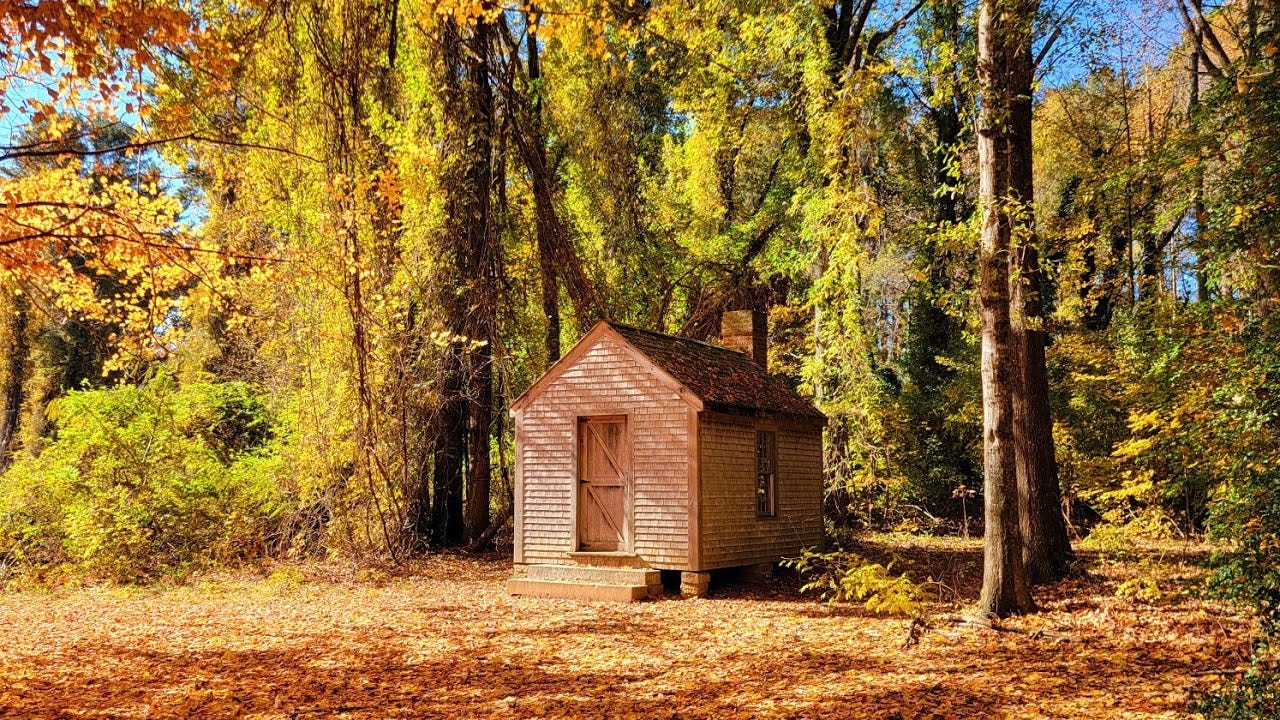
For the American, getting away from it all seems to have started when Thoreau went to Walden to live his life in the woods. Walden wasn’t that far away from his original home in Concord, Massachusetts. He could easily walk back as needed, and he did so often to eat dinner with family or friends like Ralph Waldo Emerson. Being a prolific walker, heading into town was no problem for Thoreau. His isolation was, in this respect, mostly internal, as he also received visitors. But just being on the outskirts of town, it was enough for him to help his mind escape from the kind of thoughts people had in town, to really start thinking his own thoughts. He collected those thoughts in his book Walden and now they continue to echo down the years. I think they have led to the establishment of a permanent Walden in the American mind. He moved in to his cabin on the Fourth of July, after all.
It seems appropriate to start with Thoreau when talking about vacation, considering that in the last issue I wrote about the practice of naturalism. Of all the things Thoreau was, he liked to consider himself as foremost, a naturalist. His imprint is all over the environmental movement. Yet the word vacation and the name Thoreau aren’t often thrown together, even while for many people a vacation is a way to get back to nature. At least for citified folk like myself, I often think of vacations as a journey to a place where I’m going to do some hiking, some swimming, some walking, some spending time outdoors. They’ve often included camping, and it’s always a bonus if I can get far enough away from the light pollution of the city to really be able to see the milk in the Milky Way.
As Thoreau’s good friend Emerson wrote in his essay “Nature”:
To go into solitude, a man needs to retire as much from his chamber as from society. I am not solitary whilst I read and write, though nobody is with me. But if a man would be alone, let him look at the stars. … His intercourse with heaven and earth, becomes part of his daily food. In the presence of nature, a wild delight runs through the man, in spite of real sorrows.
Restoration from real sorrows can come from being alone in the woods, in communion with the trees, bathing in the air of a forest, the light of the stars. A cabin is a place to, in Thoreau’s words, “Simplify, simplify, simplify. ” This is in contrast to the complexity of the contemporary vacation, whose planning, execution and cost often create as much stress as they are supposed to alleviate. It can be hard to simplify when our internal and external lives are a cluttered mess. Breaking from regular routines, forgetting about work, errands, and chores, and stopping long enough to allow what matters to us to register inside our minds can be considered a first step towards simplifying.
The urge to rusticate loomed large in our collective imagination even in 1845, when our population was smaller and our square concrete cities less sprawled. Despite the language Thoreau used to talk about Native Americans (“savages”), it is clear from his writing he truly admired their way of life and gives many passages of his prose to praising it. One way of looking at his experiment at Walden might be as a white man’s vision quest, a search for what a person could be in America. Thought of in this way, a vacation can be used to retreat from society at large, a tool to recalibrate ourselves to our own inner vision. A cabin retreat is a great place for such a quest.
The cabin in the woods takes on another resonance today as a possible place to “bug out” when the shale hits the fan. A person would flee to such a bug-out location if their main domicile was struck by a disaster of some kind, whether natural or man-made. Stocked up and equipped with the tools of survival, these kinds of shelters are for more than just getting back to the basics: they’re places to hunker down for shorter or extended durations. Consider working on them as a kind of vacation a prepper might have now, before taking a permanent vacation later.
Thoreau’s cabin escape was, for the most part, a solitary venture. Not all vacationers have the luxury of that kind of alone time, nor the funds for a plot of land and the permits required to build if a person wanted to keep it legal. A secondhand camper or a repurposed van is more affordable for people, as evidenced by the many modern-day nomads living in them. There are lots of people already living in campers and vans stationary as well. As the cost of oil continues to go up, living in these kinds of vehicles, parked in the yard of a family member, a vacant lot, or hidden away elsewhere, will continue to be a downwardly mobile home option.
Sometimes being alone isn’t really what a person wants anyway. Sometimes they want to get away with a spouse, family and friends. This brings us to a slight detour at summer school, or summer camp anyway, and that convivial movement of gathering together for self-improvement known as the Chautauqua.
FROM THE LYCEUM TO THE CHAUTAUQUA
The Transcendentalist movement helped to get a number of ideas and practices around education into circulation. The majority of Transcendentalist movers and shakers had worked as teachers to one degree or another. This includes Emerson and Thoreau, but also Amos Bronson Alcott, whose ideas were a forerunner to much that is taken for granted in education today, such as his taking kids on field trips to learn through experience. Field trips were a radical idea in the 1800s. Now they are standard educational practice. Thinkers like Elizabeth Peabody promoted a view of education emphasizing the innate knowledge within a person, and teaching as a way to help facilitate a flowering of what might as well be called intuition. Getting an education, then, became a mode of self-culture and spiritual refinement. As such, it was considered to be a lifelong endeavor.
In time, people would even take vacations from work to attend lectures in the summer as part of the Chautauqua movement, which had a precursor in the Lyceum movement.
The Lyceums were kickstarted in Massachusetts by Josiah Holbrook in 1826. He was another believer in the notion of self-improvement by learning across the span of an entire life, and his efforts promoted the transmission of “useful knowledge” through public lectures. After he created the National American Lyceum to teach his method of teaching, other Lyceums grew up all around the country as if a colony of fruitful mushroom spores had just erupted from the soil. By the mid-1830s there were 3,000 Lyceums catering to the public’s inclination to learn, and to be entertained while learning.
A number of the New England Transcendentalists got involved, using the Lyceum as a way to transmit their philosophy to the wider country on the speaking circuits that developed with their growth. Emerson and Thoreau were both avid Lyceum lecturers, and many of their talks were later polished up into poetic prose for publication.
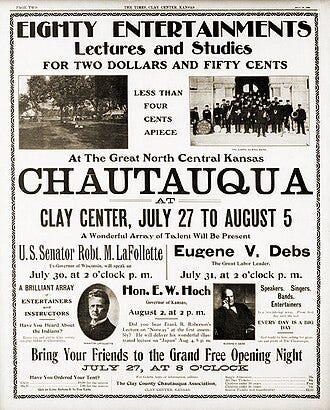
Following the chaos of the Civil War the Lyceum waned as a cultural touchstone, but in 1874 the Chautauqua waxed in its place as something of a successor. The Chautauqua started off in western New York near a lake of the same name, as a summer training program for Sunday school teachers and other churchy types. The Methodist ministers John H. Vincent and Lewis Miller were the two people behind it, and like other summer traditions, it was first organized as a camp, this one geared towards religious instruction. As interest and enthusiasm for this camp of learning grew, they loosened things up a bit to include talks on general topics, music, and recreation. The success of the Chautauqua Lake Sunday School Assembly was such that the format was copied and other Chautauquas sprouted around the country. Later in 1904 the enterprising Keith Vawter and Roy Ellison took the show on the road and presented the Chautauqua in tents as they traveled from town to town, city to city, giving people the chance to pay a modest fee to attend.
Perhaps it shouldn’t come as a surprise, considering its religious origins, that mixed in with the whole Chautauqua shebang was the idea that society could be improved through teaching citizens to be morally upstanding. As such it was in direct competition with other circuits of the time that had more in common with the circus. In other words, vaudeville. Whereas racy vaudeville offered humorous and libidinous ways to take the mind off of everyday stress, the Chautauqua billed itself as being able to improve the mind and character. As such it aimed to appeal to self-styled upper-crust highbrows, and keep out those deemed rancorous, lowbrow, and lower-class. Failing that, it would build them up into something better.
As the role of education continues to be questioned in America and change with time, the possibility of developing a new kind of summer school for “useful knowledge” might be a potential model for vacationers who want to improve their life of mind and have uplifting entertainment. As with any organic social movement, it is the people in the movement who get to decide what it is about. If I had my druthers future family summer camps would be devoted to the Humanities, Ecology, and Memory, or what I call HEM (in contrast to STEM). The world is in need of a bit of stitching after all. The inclusion of some bawdy songs and ample time dipping in a lake might be enough to keep it free from moral grandstanding and appeal to a variety of peoples. For that matter, there might as well be multiple types of summer camps catering to the needs of a diverse array of communities. After all, WASPs bent on social reformation aren’t the only ones looking for a distraction in the dog days of summer heat.
THE BUNGALOW COLONIES OF THE BORSCHT BELT
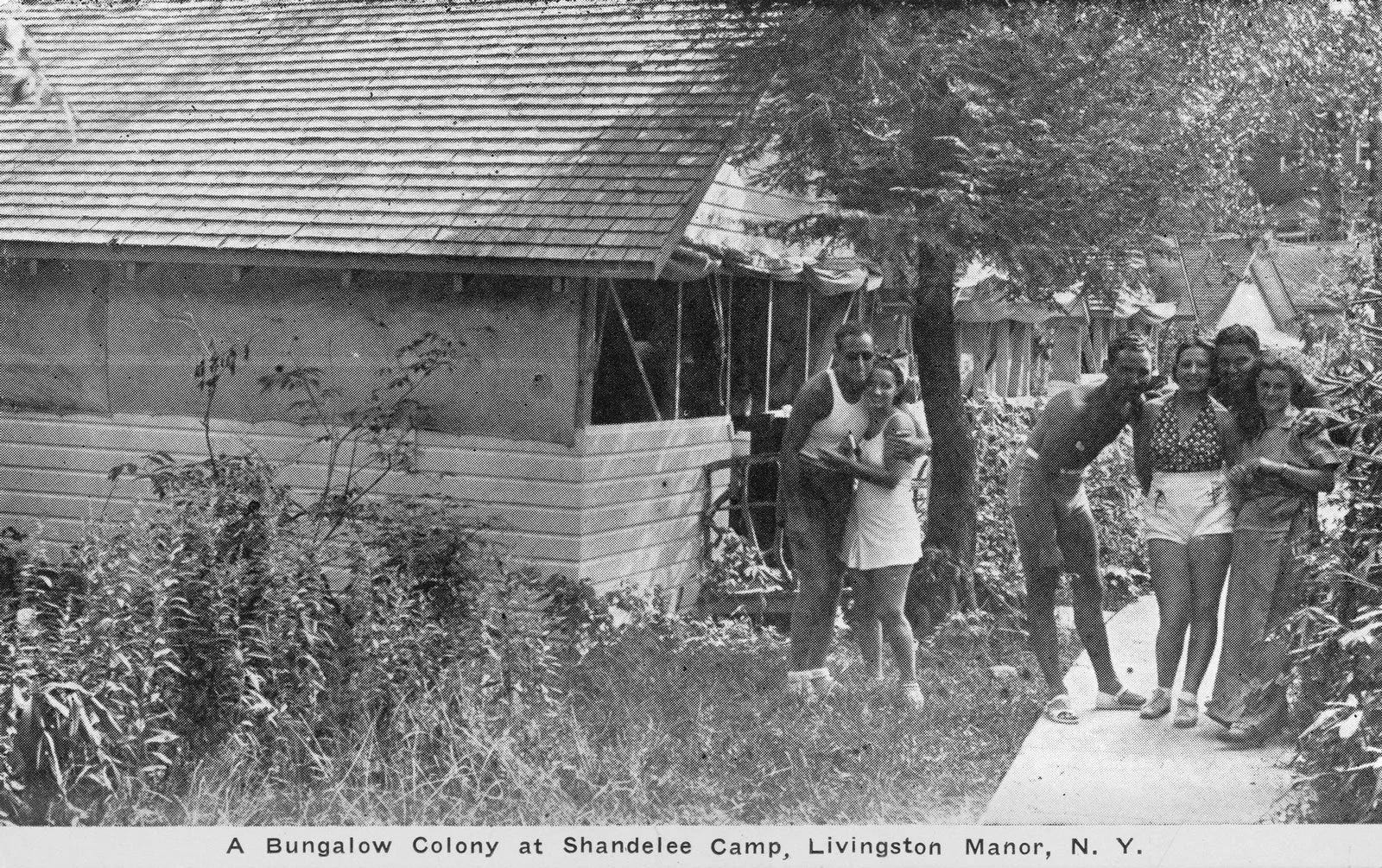
For the greater part of fifty years smack dab in the middle of the twentieth century Jewish vacationers from New York City regularly headed to the Catskill Mountains to what was called the Borscht Belt, also known as the Yiddish Alps. In a large part, it was driven by the need to get out of the hot multistory apartment buildings of the sweltering metropolis. The mothers and grandmothers would get a place at one of the five hundred resorts that catered to people at various income levels and head up with the kids as soon as they were out of school. This vacation land was in its prime between the 1920s and 1960s. Excluded elsewhere, especially during the 1930s, Jews found an oasis in the Catskills. In the seventies, the rise of affordable AC, cheaper air travel, and the decline of rail service to mountains all contributed to the downturn of these resorts and, in many cases, their eventual abandonment.
There were fancy hotels for the wealthy, but for those of lesser means, bungalow colonies and kuchaleyns. The bungalows were little cottages all grouped together. Usually just a bedroom or two, kitchenette and screened porch to play cards in when it rained or get away from the mosquitoes. The same families rented the same bungalow year after year so when the kids went up with the women for the summer, they got to meet up with their summer friends, different from the city friends they had the rest of the year. There is something about being with certain group of people for a specific set amount of time during our adolescent years that lends itself to creating a sense of enchantment.
These bungalows had communal centers where people gambled in little homespun casinos, comedians told jokes, and movies were screened in the evenings. Sometimes a musician would pop in. All of these and more were standard fare at the hotels as well. Meanwhile, the kuchaleyns were even a bit more down-at-heel than the bungalows. This Yiddish word means “cook it yourself” and was used to denote boarding houses where people could stay but no meals were provided. People went to them anyway and managed to have a good time.
Modern stand-up comedy in its present form owes quite a bit to the entertainment circuit of the Borscht Belt. Just as the Transcendentalists polished their material through Lyceum lectures, Jewish comedians crafted the art of talking routines into what we now know as stand-up comedy on these circuits. Comedians such as the late Joan Rivers cut their teeth catering to the roughly half-a-million people who went up to the Borscht Belt each summer, giving them plenty of experience for further efforts in showbiz. Others such as Sid Caesar and Jerry Seinfeld were influenced by that particular style of humor. All of this has left an indelible mark on American culture. It makes me wonder how future patterns of summer leisure, and the entertainments provided for them, will in turn influence the larger cultures in which they are nested.
During these summers it was standard for the men to stay in the city to put in their work hours for the week. By the time Friday afternoon rolled around they were eager to get in on the comedy, the card games, and time with friends and family. They got into their cars and headed up to the bungalows as fast as they could. This particular behavior is less likely to be emulated in a time of increased fuel shortages, but the other pattern, where children and their caregivers (of whatever gender) go to a kind of retreat for a part of the summer, just might. Another possibility for getting away with the whole family is to just shut everything down for a few weeks in the summer, like they do in Italy.
FROM FERRAGOSTO TO GELATO
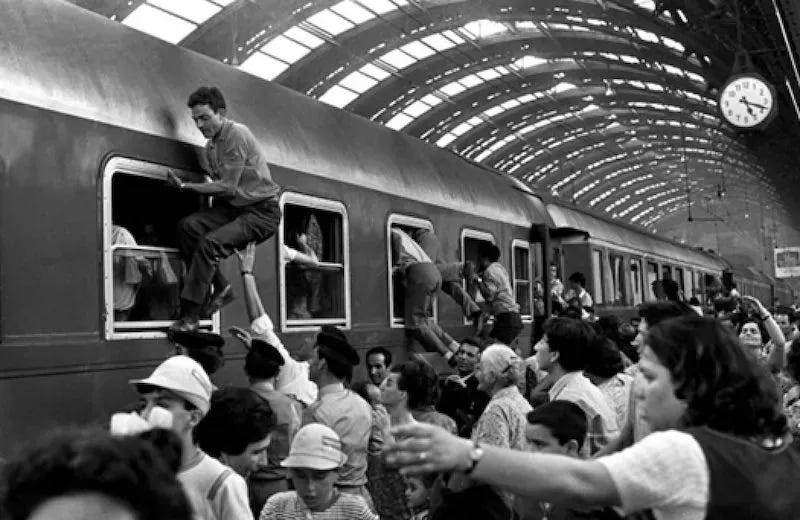
If summer has a last stand, it’s in August. The promise of a summer and its freedoms are in full bloom on Memorial Day. As Labor Day draws near those promises start to wilt. I can still relate to punk rocker Henry Rollins when he wrote, “August used to be a sad month for me. As the days went on, the thought of school starting weighed heavily upon my young frame.” I remember wanting to pack in as much time with friends as I could before the school bell rang again. August is a time when everyone might as well have one last hurrah for the summer before getting back to the grindstone, and the Italians have good enough sense to just close it all down for half of the month.
They call this time of year Ferragosto and it goes all the way back to Emperor Augustus in 18 BC. He gave the first day of August off to farmers following the rigors of the summer growing season. When the Catholic Church gained ascendancy, the holiday needed some religious mojo and got moved to August 15 to celebrate the Assumption of Mary into heaven. During the Fascist years when Benito Mussolini was in control, he threw the lower classes a bone and gave them three days off from August 14th to 16th and made tickets on the trains cheaper so they could go to museums in the cities and to their beloved beaches. People would pack up lunch supplies and head out for fun. As the twentieth century wore on, many workers got in the habit of taking a week or two off in August. Since this made it difficult for anyone else to get anything done with so many other people just taking it easy, the culture as a whole followed suit. These days Italian businesses by law give four weeks off a year, and most companies generally just close down for Ferragosto, and that word is now associated with this collective pause. Travel agents advise against going to Italy in August because many of the shopkeepers and restaurant workers are on holiday, the big cities are deserted, and everyone has gone to the beach.
Part of my interest in Ferragosto came from when I was reading about the “Lazarus Lizards” or common European wall lizard (Podarcis muralis), that was introduced to Cincinnati around 1950 by the son of the owner of the Lazarus Department store. This so-called “invasive” species is now prolific. Someone else told me how the climate here is similar to Italy (hot and humid in the summer). One branch of my family is Italian (from the town of Ripafratta, outside Pisa) and I had been reading about the kitchen gardens of Italian immigrants in the United States. Thinking of the climate being similar, I started to wonder what else I could learn from these ancestors, such as how they coped with the heat.
Soon my mind turned to gelato and how a summer vacation isn’t really a summer vacation without at least one stop at an ice cream stand. One of the most beloved of my Italian ancestors was a guy named Ice Cream Johnny. He lived from 1851 to 1943 and made his life in the hills of Kentucky outside of Frankfort. While so many of our other relatives are forgotten, we are still talking about him. That’s what being an ice cream maker will do for you. Give you immortality, or at least give your name a longer memory.
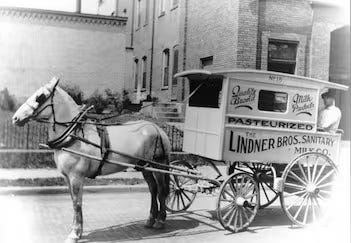
Hand-cranked ice cream freezers were invented in 1846 by Nancy Johnson in New Jersey. Before that time, ice cream was an occasional luxury for the rich. After that, with new ways for transporting and keeping ice frozen, ice cream became something even poor little whippersnappers could get as a summer treat. Ice Cream Johnny had his own dairy cows to make his ice cream with, before taking it into town on a horse-drawn wagon to sell to his fellow Kentuckians.
Hand-cranked ice cream is a low-tech process, so there is a possibility that ice cream can remain in our hot futures as long as ice itself can be kept, and the special metal-lined bucket and canister used to make it can be crafted. For that matter, shutting everything down for a two-week holiday requires zero technology. What it does require is a willingness to slow down and set aside production to practice il dolce far niente, or the sweet art of doing nothing. In a world of strict energy limits, periods of time where no work gets done can be great for everyone.
RE/SOURCES:
Aron, Cindy Sondik. Working At Play: A History of Vacations in the United States. New York, NY.: Oxford University Press, 1999.
Carter, Jamie Betesh. “Back to the Borscht Belt.” <https://www.tabletmag.com/sections/community/articles/back-to-borscht-belt-jewish-catskills-revival>
Groubert, Mark & Hunley, Eric. “Levine’s Bungalow Colonies.”
I first heard about the bungalow colonies on this episode of America’s Untold Stories. Mark Groubert is a great story teller and he tells about his time as a kid growing up and spending summers in one of the bungalow colonies. He even snuck off to visit a music festival known as Woodstock. I don’t endorse Groubert or Hunley’s political views, but for history and JFK assassination lore, the earlier episodes of their program are worth digging through.
Hayes, Brittany. “The Fourth American Institution.” <https://ushistoryscene.com/article/chautauqua/>
Joelle, Memoree. “Comedy in the Catskills: Remembering the Borscht Belt” < https://newyorkmakers.com/blogs/magazine/comedy-in-the-catskills-remembering-the-borscht-belt>
Minchilli, Sophie. The Sweetness of Doing Nothing: Living Life the Italian Way with Dolce Far Niente. London, UK.: Thorsons, 2020. This little guide to slowing down in the manner of the Italians is the perfect thing to read in a hammock.
Nichols, Ashton. Emerson, Thoreau, and the Transcendentalist Movement. Chantilly, VA.: The Teaching Company, 2006. This course of 24 lectures on DVD with accompanying guidebook was a great source of pleasure to listen to this past winter. There is no need to watch the lectures as it is just Professor Nichols talking with occasional slides. I listened to them on my headphones while working, playing the DVD in a computer. Courses from the Teaching Company are the kind of thing you might be able to find at your local library!
Provenzo Jr., E Eugene F. & Provenzo, Asterie Baker, ed. “Encyclopedia of the Social and Cultural Foundations of Education.” <http://sk.sagepub.com/ency/edvol/foundations/chpt/lyceum-movement>
Visit Italy “15th of August: origins and facts about the Italian Tradition of the ‘Ferragosto’” <https://www.visititaly.eu/history-and-traditions/ferragosto-origins-and-facts-about-the-italian-tradition-of-august-15th>
.:. .:. .:.
The writings presented here will always be free and never paywalled, but there are a few ways you can support my work: pass on the essays on to others, share the links to other sites and telling your friends. You can take out a paid subscription to this subslack if you’d like to be a patron to the arts as represented here. I have also set up a Buy Me A Coffee page, which you can find here if you would like to put some money in my rainy day coffee jar. You can buy my book The Radio Phonics Laboratory: Telecommunications, Speech Synthesis, and the Birth of Electronic Music, or my poetry book Underground Rivers, if you want to show some support and keep my writing in circulation. Thank you for your generosity!
☕️☕️☕️
Thank you to everyone who reads this and helps support the universalist bohemian art life by keeping me caffeinated and wired.
When I first learned Thoreau could just walk home I was disappointed. He pulled a classic writer move and somehow I feel he did all this to escape some relative versus a true commitment.
In this research did you happen to discover trends of vacation time? You mention the two weeks in August but I wonder if Americans had more or less vacation time some time ago.
Most starting companies, 2 weeks is the max vacation. Which, once you start spreading it out over the year isn’t any time at all.
Great exploration, Justin. I absolutely agree that we're going to have to adapt and adjust, and our summer vacations are going to have to be a part of that.
I agree about focusing more on locality and community. (Then again I think any way we can possibly return to these is going to be important going forward.) Other cultures in more tropical climates have as part of their routine a rest period during the hottest parts of the day. Heck, any retirement neighborhood in Florida would show you the same: no one risks a heart attack or a stroke by mowing their lawn past 10AM. I think it's time we started adapting similar practices in the rest of the country.