A Deep Listening Starter Pack
Don Buchla and his Box, Cisterns & Caves, Sound Poetry, Side Bands & Sending Signals to the Moon

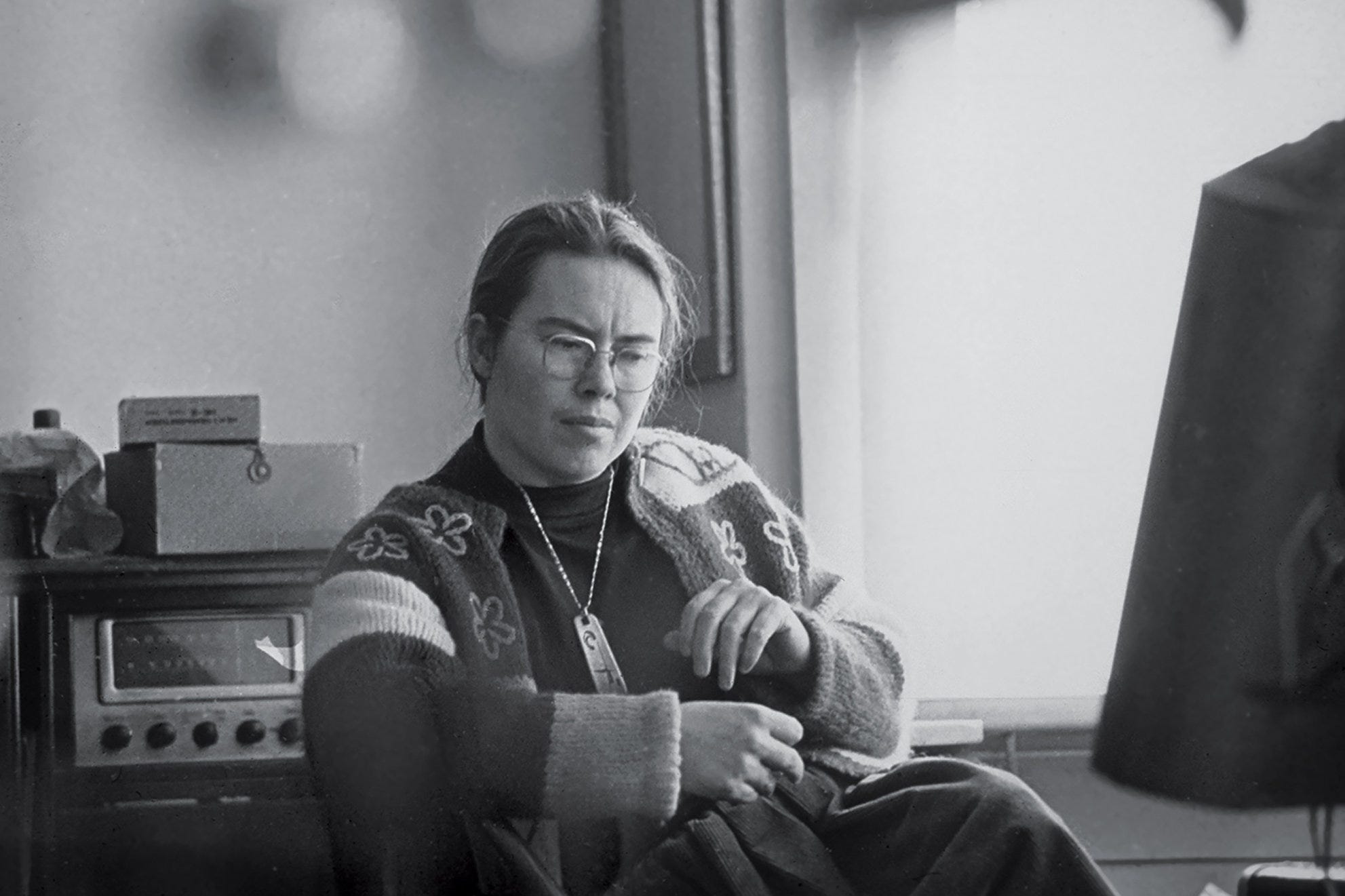
After my last article on Slowing Down and Listening Deep, I wanted to share the crux of the work Pauline Oliveros made with her life. What follows is a non-exhaustive starter pack to help kickstart your exploration of her work along with the work of some of her friends and fellow musicians.
BYE BYE BUTTERFLY
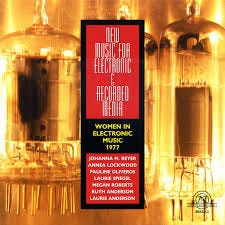
My first encounter with her work was the early electronic piece Bye Bye Butterfly. I heard it on the OHM: The Early Gurus of Electronic Music Compilation, and also on the New Worlds Record compilation, Women in Electronic Music 1977: New Music for Electronic & Recorded Media (on New World Records).
Pauline Oliveros liked to work with tape in her music, but she took a different tack than the time consuming and laborious tape editing process her friend Morton Subotnick had used in an early musique concrète piece he made for a production of King Lear. She thought the cut and splice method was all-together too intensive, so she started learning how to use the tape decks as a delay system. The use of delays, reverb and echo in various ways would become one of the cornerstones of her musical exploration. The tape machine used as delay also became the precursor to her Enhanced Interactive System (EIS) which she used in consort with her live music playing in various versions throughout her career. She also liked to record very long sections onto tape and then play them together in continuity.
Another way she learned to manipulate her sound was by varying the record and playback speeds of the tape. She also experimented with difference tones (a type of combination tone) and in doing so invented a new way of making electronic music. A combination tone is a psychoacoustic and physical phenomenon that happens when two tones are being played at the same time, causing another tone to be heard. This is generally achieved in two ways. A sum tone where the new tone is heard through adding the frequencies of the tones played. A difference tone is heard as the difference between the real tone frequencies being played
To create difference tones, Oliveros used electronic equipment with rich Lafayette tube oscillators, and set them above the range of hearing, around 40,000 hertz. This effect was exemplified in her 1965 piece created at the SFTMC, Bye Bye Butterfly.
Speaking of this in a 2016 lecture not long before her passing, she said, “I learned this from my accordion teacher, he taught me to listen to difference tones. Difference tones are the difference between two or more frequencies because they produce the difference between them below, and also above.” In her electronic music, “there would be differences between the two or three oscillators that I would use. If you know what a tube oscillator looks like, it has a big dial in the center of the face and it has the possibility of setting ranges so you can go above the range of hearing or in a certain range that is in hearing and below the range of hearing. The only way you could change the pitch of the sound was for me to turn this dial, so that was not necessarily a good way to make some music. By setting these oscillators at above the range of hearing... At 40,000, in that range, you hear the low difference tones. When I first heard the difference tone sounding, and it corroborated my way, then I added the tape delay system that was used in ‘Bye Bye Butterfly.’ The way I was playing the oscillators was by just barely turning the dials. I had reduced that aspect of oscillator playing to being able to sense where you wanted to be in an improvisational way, and by listening to what was coming out. I was listening intently, and performing, to get the sounds that I got. I was very interested in layering sounds, and in taking the same tone and then microscopically varying [it] so that you got side bands, they were called. This was a simple setup, actually, but it could produce very complex results.”
Radio operators had already figured out how to use the side bands of radio waves for communication. Pauline figured out how to use the same principle for modulation of audio waves. The seed that had come from listening to her grandfather’s crystal set and her father’s shortwave radio had morphed into the trans-formational oscillations of Bye Bye Butterfly.
ALIEN BOG
Continuing in the electronic vein are the pieces Alien Bog and Beautiful Soop.
For this piece, you can hear her emergent sense of deep listening starting to climb out of a nearby pond. “I was deeply impressed by the sounds from the frog pond outside the studio window at Mills. I loved the accompaniment as I worked on my pieces. Though I never recorded the frogs I was of course influenced by their music.” Alien Bog is wonderfully froggy.
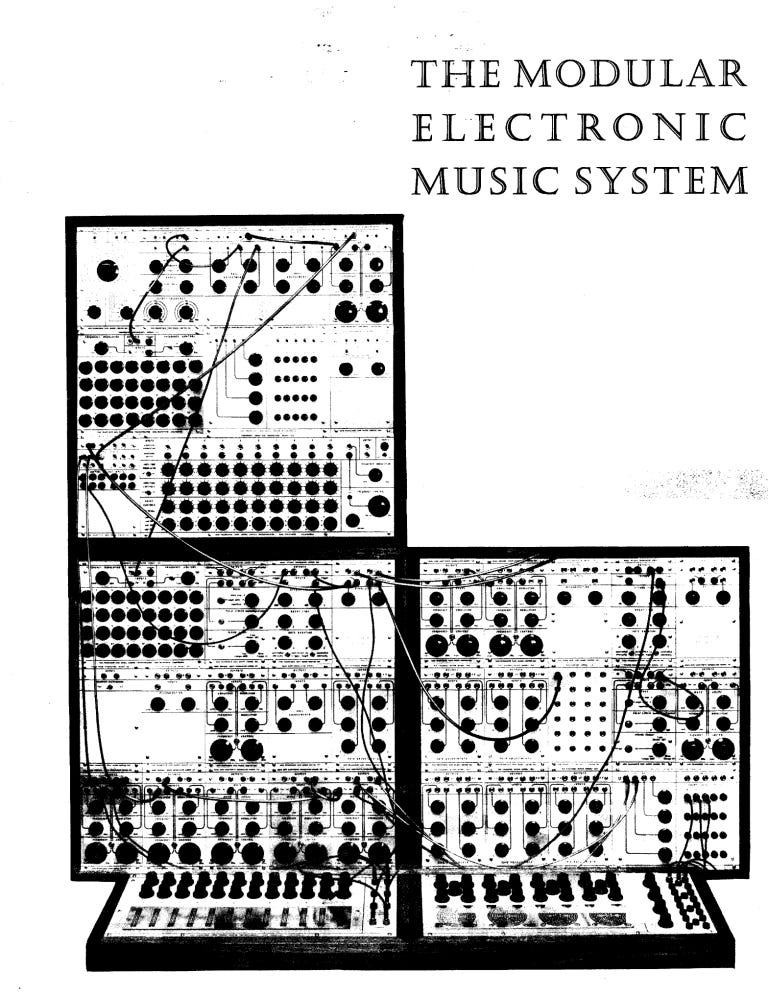
Alien Bog and Beautiful Soop stand not just as testament to the musical genius of Oliveros, but the engineering genius of Don Buchla. These pieces were created in 1966 and 1967 using one of the original Buchla 100 Boxes. Don Buchla had his own association with the SFTMC. The sounds of the early synthesizer create a rich stew of alien and amphibious vibrations, perfect for those who are fans of Tom Robbins and his book Half Asleep in Frog Pajamas.
If Don Buchla hadn’t visited the SFTMC, we might not have had the same school of west coast synthesis we do now. It was one of those historical moments that give birth to a whole new strand in the web of destiny.
Buchla had been born in Southgate, California in 1937. His mother was a teacher and his father was a test pilot. As a kid he took naturally to working with electronics and made a hobby out of building crystal radio sets, tinkering with ham radio gear, and welding his own electro-acoustic instruments together out of scrap steel and various components. When he went to college at the University of California in Berkeley and got a degree in Physics and then pursued a Ph.D. While working in that direction he got some practice in building klystrons at the Lawrence Berkely National Laboratory.
Klystron’s were the first really powerful tool for making radio waves in the microwave spectrum. The first klystron was built in 1937 by Russell and Sigurd Varian. It was made from a specialized linear beam vacuum tube that was used as an amplifier to boost the radio signals from the UHF range up to the microwave range. The low powered version of these instruments were used as oscillators for microwave relay communications links, and the high powered klystrons were used as output tubes for television transmitters and radar. They were also used to generate the strong burst of power needed for modern particle accelerators. It was for this last use that Buchla worked on these instruments. His tech-nical skill enabled him to take part in some NASA projects, as he worked towards his doctorate.
But he never got that Ph.D. The establishment at Berkeley wasn’t changing fast enough for Buchla, who got turned on and tuned in to the spiritual frequency of the sixties, and so, dropped out.
Yet school had provided him with some very important turn-ons. In addition to the klystrons and other emerging high-tech he also got exposed to musique concrète. It appealed to the same part of his creative mind that liked to make electro-acoustic instruments, and he wanted to mix his own musique concrète. His tape machine was limited in functionality, but soon, word got to him of the SFTMC where he could use their more versatile three-track tape recorder.
When Buchla, Morton Subotnick was in the studio, and Subotnick mistook Buchla for some-one he had been in contact with to design a ring modulator. It wasn’t Buchla but Buchla had the elec-tronic chops to make it happen, and it wouldn’t be that hard for him. Even more it was just the kind of thing that got Buchla energized and excited. Buchla and Subotonic talked about what could be done.
Ramon Sender was also there and Subotnick and Sender started telling Buchla how they want-ed to get away from the laborious processes involved with making electronic and electro-acoustic on tape and work with something more immediate. They wanted a tool that had the power of an analog computer but was also small enough for them to work with directly, something that could produce the results equivalent to that in a studio space but without such a cumbersome set up.
Stemming from this meeting Subotnick and Sender commissioned Buchla to build an “electroniic studio in a box.” Lucky for them they had just gotten a grant from the Rockefeller Foundation for the SFTMC’s 1964-65 season and they used five hundred dollars of that money to pay Buchla for his work.
Don had already worked with analog computers so he chose to use transistors and voltage-control for his nascent box. Voltage control was especially useful as it allowed the user to play discrete notes through the oscillators. In the electronic music that had been made with knob controlled test equipment, a composer would have to shift manually up or down through the frequencies to reach a de-sired note.
This innovation made many of the tape processes redundant (though they still have their own use and charm). The electronic composer would now be free from the task of splicing tapes of frequencies recorded off oscillators and other test equipment. This innovation also gave birth to the sequencer. Buchla had the idea to put sixteen preset voltages into his device that musicians could switch between. In doing so he moved the development of synthesizers up another step.
Buchla delivered on his commission to Sender and Subotnick in 1965. His box had ring modulators, oscillators, the sequencer and other features. It turned into quite the far out hit when it was played at the psychedelic festivals being put on by members of the counter-culture in San Francisco.
Alien Bog uses this new instrument and takes it to the furthest reaches of the cosmos, all from the comfort of the music studio.
DEEP LISTENING
My favorite music of Oliveros, though, comes from the purely acoustic realm.
Since Oliveros first started working with tape, she had always been interested in delay systems. As part of that exploration she started exploring the natural delays and reverberations found in places such as caves, silos and cisterns.
The resonant space at the fourteen foot deep, abandoned Fort Worden cistern in particular had been important in the evolution of Oliveros’s sound. It was there she descended the ladder with fellow musicians Paniotis, a vocalist, and with trombonist Stuart Dempster to record what would become her Deep Listening album. The first album of one of her ensembles, The Deep Listening Band. Supported by reinforced concrete pillars, the delay time in the cistern was 45 seconds, creating a natural acoustic effect of great warmth and beauty. This space continued to be used by musicians, including Stuart Dempster on a solo album, and the place was dubbed by them, the cistern chapel.
Pauline had another deep listening experience in a cistern in Cologne when visiting Germany. Between these experiences, the creation of the album, and the workshops she was teaching, all came to inform the further growth of her Deep Listening practice. It’s said that the term itself had started as a pun when they emerged up from the ladder that had taken them into the cistern.
Deep Listening was recorded in 1988, many decades into Oliveros expansive career at the forefront of the experimental tradition in America.
The core of the Deep Listening Band was Pauline Oliveros with her accordion and at times her EIS “expanded instrument system,” a tool used for the creation of delays and other effects; Stuart Dempster, a master trombone player and no slouch on the digeridoo and other instruments of breath. They were also joined by Panaiotis (Peter Ward) a vocalist and percussion player on many outings, and later other people rotated in and out. Their modus operandi was to play these deeply resonant places, including other locations such caves, cathedrals, and farm silos.
I listen to their first Deep Listening album again and again and again, year after year since I first heard these songs. Quintessential.
Stuart Dempster’s solo album also recorded in this amazing space is one I come back to again and again, listening to it multiple times ever year. Underground Overlays from the Cistern Chapel is an essential piece in the ouvre of deep listening. The record below was reissued by Important Records, but first came out on New World Records.
TROGLODYTE’S DELIGHT
I mentioned they also played in caves. This album is wet with humidity and the steady drip of moisture off stalactites. It glows like a white fish in a deep underground pool.
This is underground music. Very deep stuff too.
SUSPENDED MUSIC
Suspended Music came out of a collaborative project between the Deep Listening Band and work of Ellen Fullman, a composer and instrument builder. One of her lifelong projects has been the Long String Instrument that she started working on in 1980, inspired by Alvin Lucier’s Music on a Long Thin Wire and the work of other instrument makers like Harry Partch.
Her instrument, “consisted of 70-foot-long metallic wires, anchored by a wooden resonator, across which the performer moves backwards and forwards with rosin-covered fingers. The overall effect has been rightfully compared to the experience of standing inside an enormous grand piano.”
The physics of this class of instrument is also very interesting. The string ends up being so long that that the fundamental audio wave produced is transverse and below what a person can hear. The tone then becomes a beat frequency with elements of reverb or long each sounds depending on the length of the string and the produced audio wave. Such explorations of sound physics have themselves been fundamental to the work of experimental musicians who seek to exploit these properties for artistic effect.
The instrumentation for the collaboration on Suspended Music included Fullman’s Long String Instrument, Oliveros’s expanded accordion, and Dempster’s virtuoso trombone and didjeridu as well as David Gamper’s voice, spatial distribution, manipulation and sound design, timbral transformation, and technical coordination. They were joined by Ellen’s ensemble, The Long String Instrument band, who included herself Elise Gould, Nigel Jacobs, and Rocio Balderas.
Check out Suspended Music on Archive dot org.
NILE NIGHT
The poetry of her partner Ione also became a regular source of inspiration. Their collaborative album Nile Night, with Ione’s reading of her poets of initiatic and mystical Egypt make this an entire revelation – a must for poets who are interested in sound poetry. The words swim in a pool of magic. The sounds come from multiple sources and the entirety is mesmerizing.

FOUR MEDITATIONS / SOUND GEOMETRICS
The Deep Listening practice was tied to meditation and spiritual exploration from the beginning. In these four meditations she helps listeners journey along the sacred geometry of sound.
She was classically trained and wrote chamber pieces. These two fall into the category, while still remaining firmly in the experimental idiom.
“Meditation for Orchestra asks the performers to listen then sound. Listen means to include all that is sounding and to find a space for each sound that is made.”
The three sections of Sound Geometries for Chamber Orchestra are “intended to guide the players in their feelings and approaches to conducted, guided and improvisational music making to create differing atmospheres for each of the three sections. Players sounds are picked up during the performance by microphones, processed in one of ten geometrical patterns by the Oliveros designed Expanded Instrument System (EIS) to transform and move the player’s sounds in space in the 5.1 surround sound system.”
ECHOES FROM THE MOON
The last work I am going to explore, we do not have a recording of. I do have a video to share, and it uses the same principal she used here, using the moon as something to bounce a sound signal off of via radio waves. This same approach was later employed by Hainbach. His video of the process is below. He even built a plug in with Audio Thing to replicate the sound, should wish to do the experiments without all the set up and gear.
For this part, let’s get into the history of one of the most epic delay and echo systems Oliveros was able to work with and create. Pauline first had the idea for the piece when watching the lunar landing in 1969.
The idea of bouncing a signal off the moon, which amateur radio operators had learned to do as a highly specialized communications technique, was another way of exploring echoes and delays. She was able to achieve this with the help of Scott Gresham-Lancaster a member of the network music collective, The Hub, and some helpful ham radio operators.
“I thought that it would be interesting and poetic for people to experience an installation where they could send the sound of their voices to the moon and hear the echo come back to earth. They would be vocal astronauts. My first experience of Echoes From the Moon was in New Lebanon, Maine with Ham Radio Operator Dave Olean. He was one of the first HROs to participate in the Moon Bounce project in the 1970s. He sent Morse Code to the moon and got it back. This project allowed operators to increase the range of their broadcast. I traveled to Maine to work with Dave. He had an array of twenty four Yagi antennae which could be aimed at the moon. The moon is in constant motion and has to be tracked by the moving antenna. The antenna has to be large enough to receive the returning signal from the moon. Conditions are constantly changing - sometimes the signal is lost as the moon moves out of range and has to be found again. Sometimes the signal going to the moon gets lost in ga-lactic noise. I sent my first ‘hello’ to the moon from Dave’s studio in 1987. I stepped on a foot switch to change the antenna from sending to receiving mode and in 2 and 1/2 seconds heard the return ‘hello’ from the moon.”
Though farther away in space than the walls of the Worden cistern, the delay time between the radio signal going there and coming back is much shorter. In a vacuum radio waves travel at the speed of the light. Earth Moon Earth, or EME as it is known in ham radio circles was first proposed by W. J. Bray, a communications engineer who worked for Britain’s General Post Office in 1940. At the time, they thought that using the moon as a passive communications satellite could be accomplished through the use of radios in the microwave range of the spectrum.
During the forties the Germans were experimenting with different equipment and techniques and realized radar signals could be bounced off the moon. The German’s developed a system known as the Wurzmann and carried out successful moon bounce experiments in 1943. Working in parallel was the American military and a group of researchers led by Hungarian physicist Zoltan Bay. At Fort Monmouth in New Jersey in January of 1946 John D. Hewitt working with Project Diana carried out the second successful transmission of radar signals bounced off the moon. Project Diana also marked the birth of radar astronomy, a technique that was used to map the surfaces of the planet Venus and other nearby celestial objects. A month later Zoltan Bay’s team also achieved a successful moon bounce communication.
These successful efforts led to the establishment of the Communication Moon Relay Project, also known as Operation Moon Bounce by the United States Navy. At the time there were no artificial communication satellites. The Navy was able to use the moon as a link for the practical purpose of send-ing radio teletype between the base at Pearl Harbor in Hawaii, to the headquarters at Washington, D.C. This offered a vast improvement over HF communications which required the cooperation of the iono-spheric conditions affecting propagation.
When the artificial communication satellites started being launched into orbit the need to use the moon for communicating between distant points was no longer necessary. Dedicated military satellites had an extra layer of security on the channels they operated on. Yet for amateur radio operators the allure of the moon was just beginning, and hams started using it in the 1960s to talk to each other. It became one of Bob Heil’s favorite activities.
In the early days of EME hams used slow-speed CW (Morse Code) and large arrays of antennas with their transmitters amplified to powers of 1 kilowatt or more. Moonbounce is typically done in the VHF, UHF and GHz ranges of the radio spectrum. These have proven to be more practical and effi-cient than the shortwave portions of the spectrum. New modulation methods also have given hams a continuing advantage on using EME to make contacts with each other. It is now possible using digital modes to bounce a signal off the moon with a set up that is much less expensive than the large dishes and amounts of power required when this aspect of the hobby was just getting started.
“For instance, an 80W 70 cm (432 MHz) setup using about a 12-15 dBi Yagi works well for EME Moonbounce communication using digital modes like the JT65,” writes Basu Bhattacharya, VU2NSB, a ham and moonbouncer located in New Delhi, India.
On the way to the moon and back, the radio path totals some 50,000 miles and the signals are affected by a number of different factors. The Doppler shift caused by the motion of the moon in rela-tion us surface dwellers is an important factor for making EME contacts. It is also something that ef-fected the sound of the Pauline’s music when it got bounced off the lunar surface.
“The sound shifted slightly downward in pitch… like the whistle of a train as it rushes past,” said Oliveros of her performance.
“I played a duo with the moon using a tin whistle, accordion and conch shell. I am indebted to Scott Gresham-Lancaster who located Dave Olean for me in 1986 and helped to determine the technology necessary to perform Echoes From the Moon. Ten years later Scott located all the Ham Radio Operators for the performance in Hayward, California which took place during the lunar eclipse September 23, 1996. Following is the description of that performance:
The lunar eclipse from the Hayward Amphitheater was gorgeous. The night was clear and she rose above the trees an orange mistiness. As she climbed the sky the bright sliver emerged slowly from the black shadow - crystal clear. The moon was performing well for all to see. Now we were ready to sound the moon.
“The set up for Echoes From the Moon involved Mark Gummer - a Ham Radio Operator in Sy-racuse New York. Mark was standing by with a 48 foot dish in his back yard. I sent sounds from my microphone via telephone line in Hayward California to Mark and he keyed them to the moon with his Ham Radio rig and dish and then he returned the echo from the moon. The return came in 2 & 1/2 sec-onds. Scott Gresham-Lancaster was the engineer and organized all. When the echo of each sound I made returned to the audience in the Hayward University Amphitheater they cheered. Later in the evening Scott set up the installation so that people could queue up to talk to the moon using a tele-phone. There was a long line of people of all ages from the audience who participated. People seemed to get a big kick out of hearing their voices return - processed by the moon. There is a slight Doppler shift on the echo because of the motion of both earth and moon. This performance marked the premiere of the installation - Echoes From the Moon as I originally intended. The set up for the installation in-volved Don Roberts - Ham Radio Operator near Seattle and Mike Cousins at Stanford Research Insti-tute in Palo Alto California. The dish at SRI is 150 feet in diameter and was used to receive the echoes after Don keyed them to the moon. With these set ups it was only possible to send short phrases of 3-4 seconds. The goal for the next installations would be to have continuous feeds for sending and receiv-ing so that it would be possible to play with the moon as a delay line.”
It’s a set up that could work for other musicians who want to realize again Oliveros’s lunar delay system. German electronic musician and YouTuber Hainbach did just that as described in this video:
The thrill of hearing a sound or signal come back from the moon remains, and if creative individuals get together to explore what can be done with music and technology, new vistas of exploration will open up.
.:. .:. .:.
The writings presented here will always be free and never paywalled, but there are a few ways you can support my work: pass on the essays on to others, share the links to other sites and telling your friends. You can take out a paid subscription to this subslack if you’d like to be a patron to the arts as represented here. I have also set up a Buy Me A Coffee page, which you can find here if you would like to put some money in my rainy day coffee jar. You can buy my book The Radio Phonics Laboratory: Telecommunications, Speech Synthesis, and the Birth of Electronic Music, or my poetry book Underground Rivers, if you want to show some support and keep my writing in circulation. Thank you to all my readers and supporters. Your generosity means the world and helps support my universalist bohemian art life! Thanks for keeping me caffeinated and wired.
☕️☕️☕️
Well, my weekend listening is now spoken for! Thanks so much for putting these together, Justin, they're always great for Bandcamp Fridays. :)
The moon bounce stuff is pretty trippy. I have never done that but I did use an amateur satellite once. And that itself is kinda cool because you have to track that thing through the sky with a yagi like it is some sort of world war II ballistic -- which it basically is.
There's too much deep listening on here to hear, so I only stuck my toe in. The cave dripping sounds were pretty cool I can see how it is used in meditative practices.